
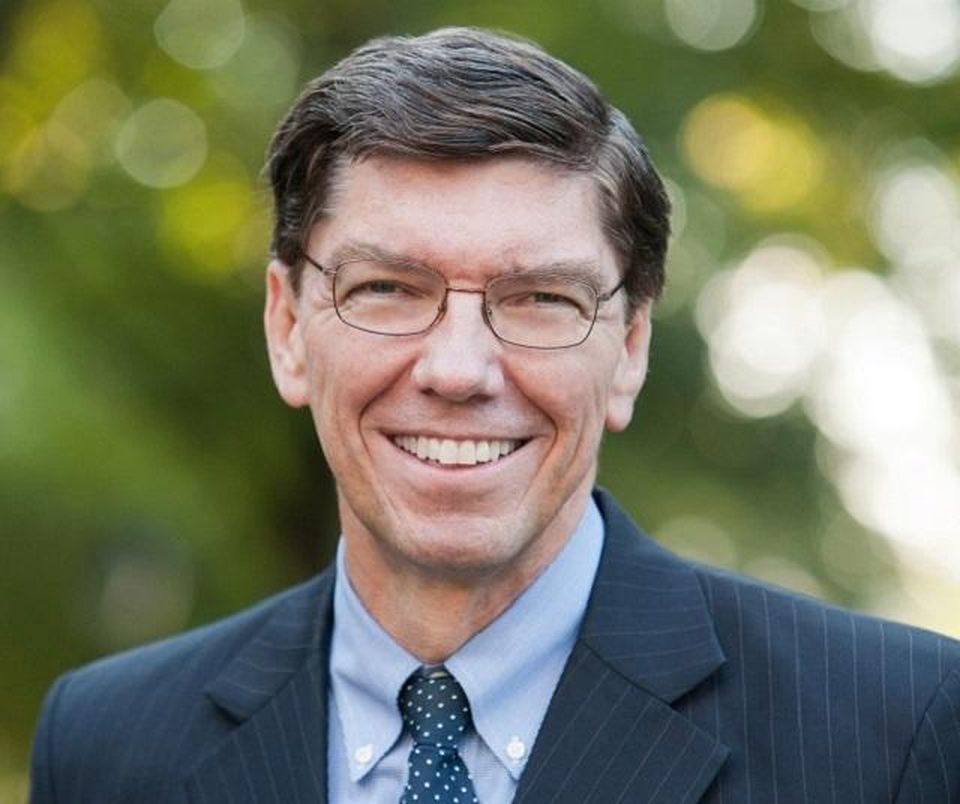
With Clay Christensen's passing earlier this year we've reflected on the impact that he had throughout his remarkable life. We miss him and our hearts go out to his family members during this time of mourning. We also celebrate the contributions, inspiration, and example he provided–our organization and our lives would certainly be very different, and much poorer without his influence. The excerpt below, written by Jeff Dyer, is a small tribute to his life and our gratitude to him.
Clayton Christensen is best remembered for disruption theory—Clay's explanation for why great companies fail to respond effectively to new entrants with an offering at the “low end” of the market. But I best remember Clay for his ideas about the process of discovering new innovations (the focus of our work together with Hal Gregersen that led to The Innovator's DNA).
Clay had a view on how breakthrough ideas happen that he shared one day with me and Hal during the course of our research. Clay was a master teacher—he could grab you with a story or example that would brilliantly illustrate the idea or “theory” he was trying to teach (can anyone forget the “milkshake” example?). Clay believed that new ideas often emerge because someone is willing to pay attention to an “anomaly”—a surprise that doesn't seem to fit existing theory or explanations of how the world works. He told us that this was a key observation made by Thomas Kuhn, in his landmark book on the history of science, The Structure of Scientific Revolutions. Kuhn argued that scientific breakthroughs happen—and new and improved theories emerge—when a researcher observes the world well enough to identify and explain an anomaly. The discovery of an anomaly—a surprise—gives scientists the opportunity to revisit a particular theory in an attempt to better understand it. This often leads to a modification or improvement of the theory by understanding and explaining the anomaly. Similarly, when business innovators discover an anomaly—a surprise—this is when true learning takes place. Surprises lead to the discovery of opportunity and new ways to create value. Clay loved to talk about the discovery of anomalies as the catalyst for both scientific and commercial innovations—and observed that it was directly relevant to his own discoveries about disruptive innovation.
He went on to explain that early studies on the impact of technological innovation on established firms concluded that established firms, on average, do well when faced with incremental innovation, but stumble when confronted with radical change. But there were anomalies to this general conclusion. Some established firms successfully implemented radical technology change. To account for these surprises, he told us that Mike Tushman and Philip Anderson (1986) offered a unique, new categorization: competency-enhancing versus competency-destroying technological changes. This resolved many anomalies, yet subsequent researchers continued to uncover new ones that the Tushman-Anderson scheme could not explain. Clay's own work on sustaining versus disruptive technologies provided new insights as to why incumbents failed to respond to new innovations even when they had the technological capabilities to replicate the disruptive technology. Clay's bottom line: identifying surprises or anomalies—what is unexpected—may be the key to unlock the door to your innovation. It's not surprising that he had a sign outside his door that read “Anomalies Wanted”.
Clay understood the need to actively observe the world to see anomalies and trigger new ideas. Clay was a doer. Even when his health was failing, he was actively meeting with new people and new organizations to share his ideas and to ask for feedback on his ideas. He was a deeply religious man who actively lived his faith—and actively shared his belief in God as a loving being who understood the causal rules of the universe and was the designer of our learning experience here on earth. Remembering Clay means that I will likewise choose to actively observe the world and seek for truth; and when I find it, I will share it in hopes of making the world a better place for everyone. That's what Clay did. He made the world a better place.


